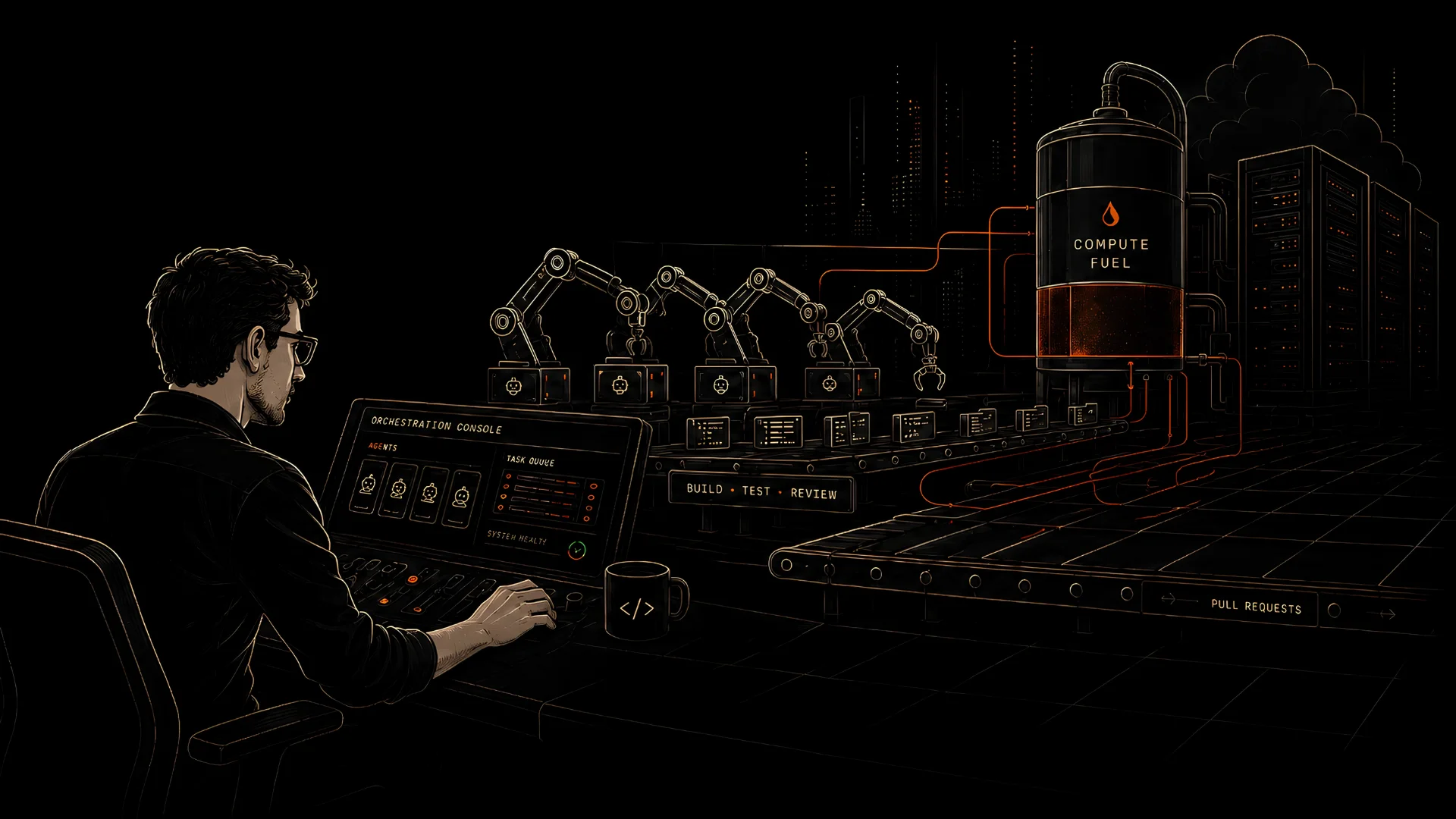
Across a recent nine-week stretch I merged 1,256 pull requests into a single repository. In the six most intense weeks I sustained around 25 to 30 PRs a day, with a peak day of 78. I have not personally written a line of code since July 2024, but my way of coding has changed a lot since then. A software engineer today is a completely new profession compared to what it was just a few months ago. (receipts). I produced in two months what I used to produce in two years. That is around a 10x increase in my output. And it also reflects on the budgets companies pay for AI.
If you costed an engineer at that level out honestly, not at the subscription bill they actually see but at the API price of every token they burn through, you would land somewhere near 360,000 euros a year. The salary line is a senior European engineer, around 120,000. The remaining 240,000 is compute, around half of it currently absorbed by the labs that sell it.
The numbers in the previous two paragraphs belong to the same person. The first is what they produce. The second is what they burn. The first is on a GitHub dashboard. The second is not on any invoice anyone sees today. But it will be on someone’s invoice soon enough.
Output and cost used to move together for a software engineer. They no longer do. That decoupling is what the rest of this post is about, and what it means for engineers, the companies that hire them, and the labs that are quietly footing half the bill.
A small note on the “10x” I am going to use throughout this piece. It is the floor, not the ceiling. In my own experience the output multiplier runs anywhere from 10x to 100x depending on the task, the sector, and how cleanly the work breaks down. I am sticking to 10x for the rest of the post because the math then stays clean and the conclusion does not need anything more aggressive than that.
Output is not productivity anymore
For thirty years, the productivity of a software engineer was a labor question. You hired a person, you paid them a salary, and the output of the team scaled, more or less linearly, with how many people you had. The cost of a developer was essentially the cost of a developer. A chair. A laptop. And a few software licenses. The capital ratio of the profession was close to zero.
That math died in 2025.
In 2026, output and cost have decoupled. An engineer with a serious agentic setup, doing real work, is burning compute on the order of magnitude of their own salary. Sometimes more. The cost of the human is now joined by a second cost, the cost of the machines doing the work the human used to do. Software engineering, quietly and without anyone calling it that, has crossed from being a labor-intensive profession to being a capital-intensive one.
So when somebody says “I am ten times more productive with AI,” that sentence is doing two different jobs that we now need to separate.
Output: how much shipped work comes out of your week. Mine is roughly ten times what it was. So is the output of every engineer I know who is doing this seriously.
Productivity: output divided by cost. How much shipped work per euro spent on the engineer, their tools and their tokens. That is a smaller number than the output gain, because the denominator has grown too.
Plainly: pre-AI, one engineer at one salary produced one unit of output. Productivity was 1. Today the same engineer produces ten units, and burns three times the money to do it. Output is now 10. Productivity is 10 divided by 3, around 3. Same person. Two very different numbers.
This post is about that second number, and what it means.
The token bill the market is hiding from you
Let me put real numbers on the table. One subscription, one engineer, one year. The simplest possible setup.
| Cost line | Amount per year |
|---|---|
| Salary (senior European engineer) | €120,000 |
| Subscription (one Claude Max 20x seat) | €2,400 |
| API tokens you personally pay in heavy build months | ~€120,000 |
| Same again, in compute the lab absorbs on top of your subscription | ~€120,000 |
| Fully loaded cost at API prices | ~€360,000 |
The subscription looks small. It is not. Anthropic charges Max 20x at roughly one tenth of the equivalent API cost. That is penetration pricing, the same playbook Uber ran on rides and DoorDash ran on food. You are not paying for compute, you are paying for the loyalty option. The lab is buying your habit with investor money. For a heavy operator, the unbilled compute the lab absorbs through that one seat sits in the same order of magnitude as the API tokens you do pay for. That is the fourth row in the table.
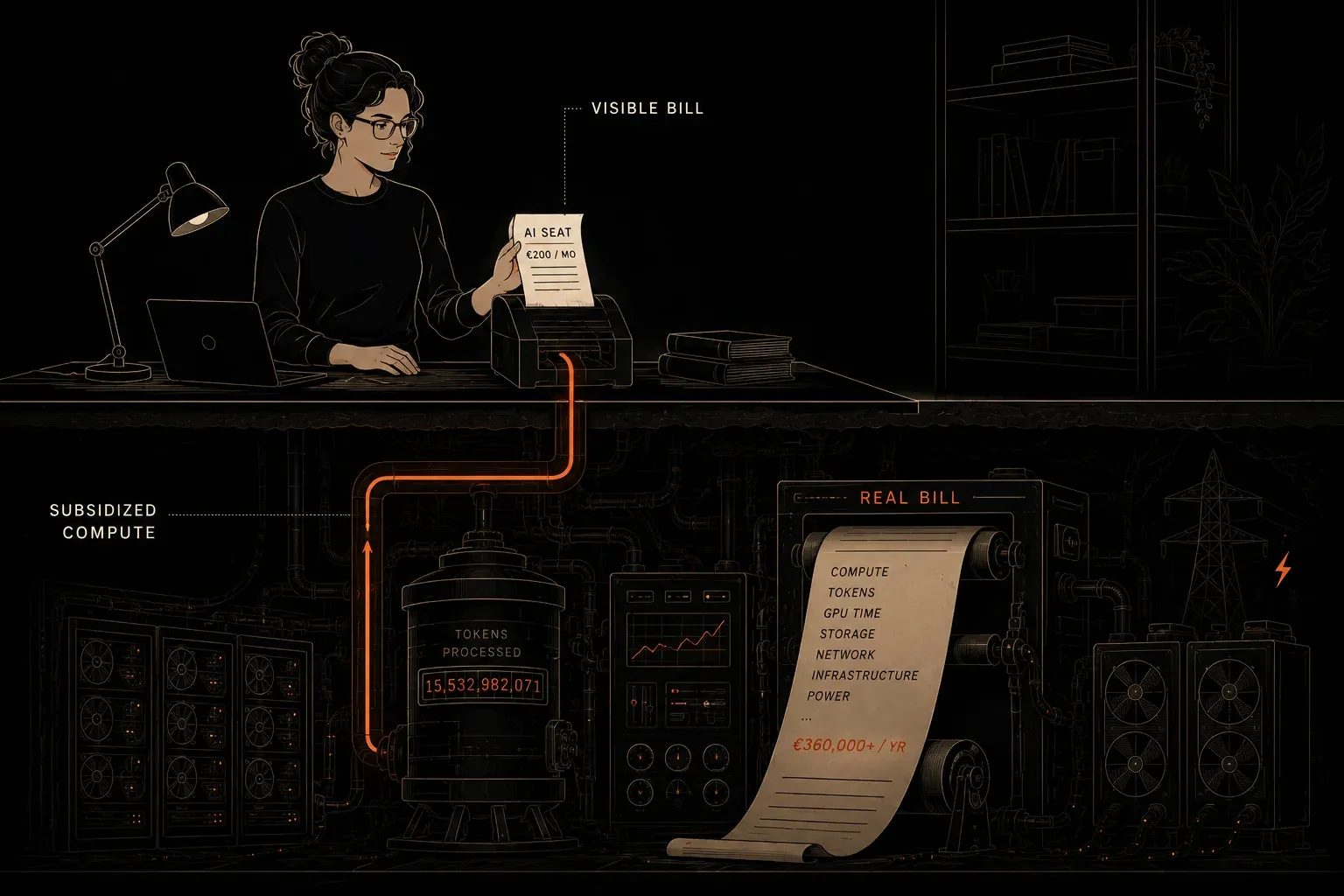
The €120,000 a year in direct API tokens shows up in heavy months when you push a project hard. It is not steady state for every developer, but it is steady state for anyone who has internalised that right now, the biggest blocker to building is how much money you can convert into tokens.
Add it all up and you get the inconvenient truth. The fully loaded cost of one engineer working at the frontier of agentic coding, priced honestly against the API menu, is around three times their salary.
Goldman Sachs has seen the same shape in equity research on the buy side. They surveyed forty enterprise software companies and reported, with a straight face, that inference costs were approaching ten percent of total engineering headcount cost at one of them, and that they expected parity with engineering salaries within several quarters. The 1:1 ratio is not theoretical. It is on the runway.
Most companies do not see this yet because they are paying the subscription price, not the API price. Their CFO looks at a 200 dollar monthly seat and thinks AI is the bargain of the decade. The real price is being absorbed by Anthropic, OpenAI and the rest, who are funded by VCs and private markets to do exactly that until the moats are dug.
The next AI bubble, the one a few people have been writing about, is not going to be about model capability stalling. It is going to be about the price stack getting honest.
The new productivity equation
Now we can do the arithmetic.
Take that senior engineer in Europe, costing roughly €120,000 a year fully loaded. Pre-AI, they produced one unit of output a year. Productivity per euro, normalised, is 1.0.
Today the same engineer, with a new agentic-orchestration skill set and an agentic harness around them, costs roughly €360,000 fully loaded at API prices (€120k salary plus €240k in compute, paid and absorbed combined) and produces ten units of output. Productivity per euro is 10 / 3, around 3.33.
The 3x agentic coder is that ratio. Not three times the output. Three times the productivity, with the output running well ahead, the cost running well ahead, and the ratio landing around three once the bill is honest.
There are honestly three different numbers you can quote, depending on whose accounting you are doing.
| Whose books | Cost | Output | Productivity |
|---|---|---|---|
| Today, the engineer’s pocket | €120k salary + ~€120k API they personally pay | 10x | ~4x |
| Today, the CFO’s books | €120k salary + €2.4k subscription | 10x | ~10x |
| Steady state, no subsidies | €120k salary + €240k compute at full API rate | 10x | ~3x |
The middle line is why every aggressive tech CEO is currently rewriting their org chart. If you can buy something close to ten units of productivity for the price of one engineer with a subscription, you do not just hire more engineers. You make a different company.
The bottom line is what is left when the bill comes due. Still the largest single jump in software engineering productivity in thirty years. Just not ten times.
Most engineers are not 3x. They are 1.2x.
This is the part that nobody wants to write.
If you read AI Twitter, you see people shipping production code in twenty minutes and posting screenshots of agents merging PRs while they sleep. That is real, and it is a tiny slice of the developer population. I have been seeing the rest of the distribution up close. I interviewed a lot of engineers this year, and most of them are using AI the way I was using it in early 2024.
The hard evidence is on both sides.
On the optimistic side, the GitHub and Microsoft Research study from 2023 found that developers using Copilot finished a synthetic HTTP server task 55 percent faster than the control group. Ethan Mollick has consistently reported 20 to 30 percent productivity gains in controlled experiments across consulting and coding.
On the pessimistic side, METR ran a randomized controlled trial in mid-2025 with 16 experienced open source developers working on their own repositories using Cursor and Claude 3.5 Sonnet. The result was striking. Developers given access to AI took 19 percent longer to finish the same tasks. The same developers, before the study, predicted they would be 24 percent faster. After the study, they still believed they had been 20 percent faster. The illusion of speed survived contact with the data. METR has since updated their experiment design because late-2025 models changed the picture, but the headline result keeps getting cited.
I read those numbers differently. METR measured something real, just not productivity. They measured what happens when you give a new tool to a worker who keeps the old habits.
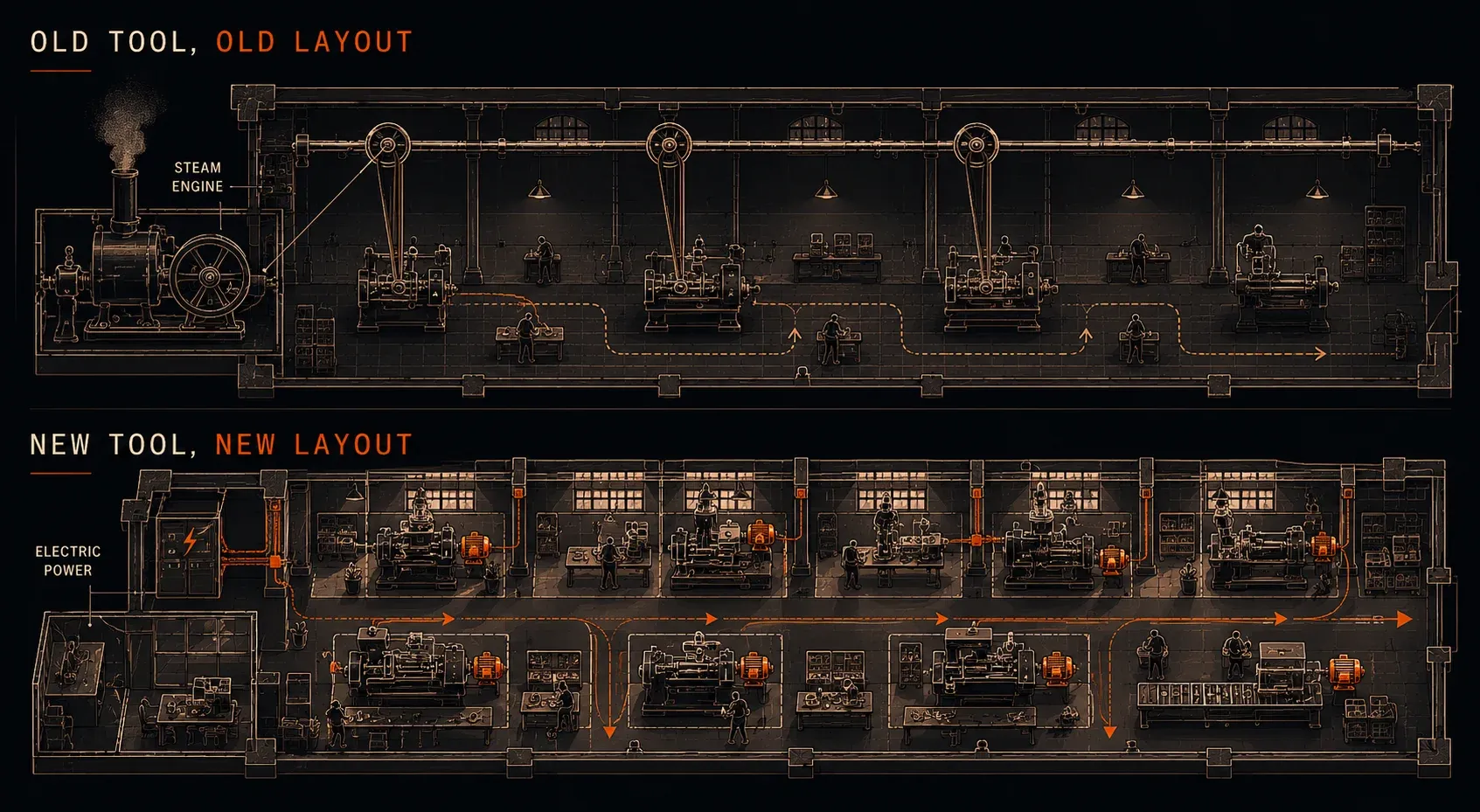
The closest historical parallel is electrification. When American factories first replaced steam engines with electric motors in the 1900s and 1910s, productivity barely moved for almost two decades. The motors went into the same factory layout the steam engine had imposed: a central power source, long shafts and belts running the length of the building, machines bolted to whichever spot was close to the shaft. Nothing changed except the energy source. The productivity gain only arrived when a new generation of plants was designed around what the electric motor actually allowed, which was distributed power. Machines arranged by workflow, not by their distance to the boiler. Standalone motor per station. The tool had always been more productive. The layout of the work had to catch up.
AI in coding is the same story, compressed. METR’s developers were typing the same way, reviewing the same way, shipping the same way, with a model whispering suggestions at them. The model gave them no leverage because the layout of their work did not change. The 10x people are the ones who tore the layout down and rebuilt their day around the agent.
Zoom out further and the picture compresses even more. A February 2026 NBER survey of nearly six thousand CEOs and CFOs found that ninety percent of firms saw no measurable productivity gain from AI. Two and a half trillion dollars spent globally on AI in 2026, and we are reliving Solow’s old joke from 1987: you can see the computer age everywhere except in the productivity statistics.
Read together, these are not contradictions. They are a distribution. The output of individual developers is shifting from normal to power law. A small group at the top is genuinely 10x, or even more. A large middle is somewhere between 1.1x and 1.3x with AI on. A long tail is, like METR’s senior open source maintainers, slightly slower because the cost of reading bad output exceeds the savings on good output for their specific work.
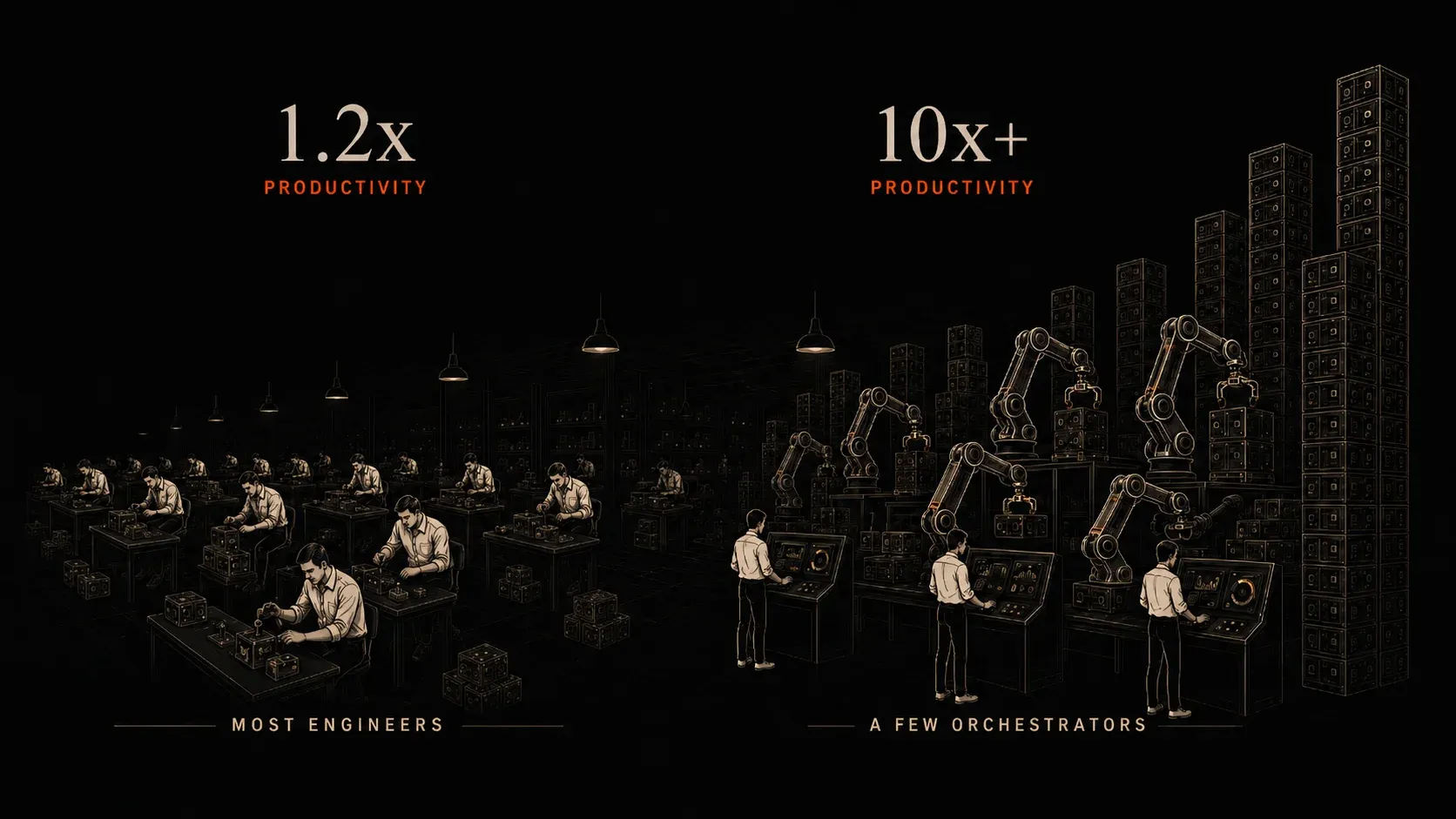
The split has a name. I wrote a whole post about it: an engineer is either still trying to micromanage code, or they have stepped up to orchestrating the system that produces code. The micromanagers are the 1.2x. The orchestrators are the 3x. The gap between them is widening every month, and it is widening fastest at exactly the firms where leadership thinks “well, we gave everyone a Copilot seat.”
What ClickUp and Block are telling you
While the rest of the market is still debating whether AI is a productivity tool or a productivity mirage, two companies have shipped the answer in their cap table.
In May 2026 ClickUp, a 4 billion dollar productivity company, cut 22 percent of its workforce and introduced salary bands that reach 1 million dollars a year in cash for anyone in the company who produces, in CEO Zeb Evans’s words, “100x impact” by building or operating AI systems. He calls the new structure the 100x org. At the same time, Fortune reported that ClickUp now runs roughly three thousand internal AI agents across its departments, a 3 to 1 ratio of agents to people.
That is one company turning the math in this post into a comp plan. Salary bands that previously topped out at six figures are now four times higher for the people who can ride the leverage. Headcount is down 22 percent because the people who cannot ride the leverage no longer pay for themselves.
Three months earlier, Jack Dorsey did the same thing without the bands. Block cut its workforce from over 10,000 to just under 6,000, a forty percent reduction in one announcement. The stock went up 25 percent on the news. @akshaymarch7 captured the moment: “the markets are now celebrating layoffs as a positive sign, as if human employees are liabilities for companies.”
What the market was actually celebrating is more specific. Block’s revenue per employee was already strong before the cut. After the cut it sits at elite level. The market re-priced the company on the assumption that the remaining 6,000 people, with serious AI leverage, can carry the workload of 10,000. If they can, the multiple is justified. If they cannot, the stock gives the gain back.
ClickUp is the optimistic version of the same trade. Block is the brutal version. Both are pricing the same belief: that the multiplier exists, that it is large, and that it is concentrated in fewer people. Worth noting, the part of the story most punditry skips: most companies have a lot of fat, and AI is the excuse, not always the cause. The cuts that are coming are partly leverage and partly long overdue.
Either way, the implication for engineers is the same. The market is paying you for the multiplier you can carry, not for the chair you occupy.
The capital ratio of the profession
Now comes the part of the post that I believe might bring you another newer perspective, at least from what I see from the AI-Twitter conversation.
Pre-2025, a software engineer was a labor input. The capital cost of putting that person to work was negligible, even at the most extravagant. SaaS bills, a developer machine, an IDE license. Round it to zero. Output was labor. Cost was labor. Productivity was a labor question.
In 2026, that has flipped quietly. At my level of usage, which matches what I see around me, the capital cost of putting me to work is twice the labor cost. The ratio is 2 to 1, excluding token subsidies. As the subsidies retreat, the steady-state ratio probably settles between 1:1 and 2:1 for senior engineers operating at the frontier.
For an engineer who is still typing code by hand with a chatbot on the side, the capital ratio barely moves. The brutal part is not that they cost too much, they do not. It is that they ship at 1x while the operators next to them ship at 10x. The new gap is not a cost gap. It is an output gap, and the opportunity cost falls on the person who never learned to spend the budget.
Here is the interesting part.
We have crossed, in eighteen months, from a labor-intensive profession to a capital-intensive one. The closest historical analogues are when the carpenter moved from hand tools to CNC machinery, or the farmer moved from a hoe to a tractor. Those transitions took decades. Ours is taking eighteen months. I drew the picture for it myself in the hiring post: on one side the artisan working every grain of wood, on the other side the operator of a robot factory. Same shift, compressed.
The consequences are unfolding in real time:
- The engineers who can operate the machines command a 56 percent wage premium, up from 25 percent in 2024. The largest single-year repricing of knowledge work on record.
- At the frontier labs, the same job pays 600,000 to over a million dollars in total comp, because the leverage is even larger.
- The engineers who cannot operate the machines are increasingly disposable, in BPO, in customer service, in junior engineering. Dario Amodei has been warning about this for a year. The exposure is real.
- The companies that misread the new ratio are blowing through inference budgets by orders of magnitude, because the old governance mechanism, budget, has lost its grip and a new one has not formed yet.
- Goldman Sachs estimates 7.6 trillion dollars of capital flowing into compute, data centers and power between 2026 and 2031 to make the new ratio possible.
And on the demand side, the macro signal is just as loud. The most recent Charts of the Week from a16z, summarising data from Bloomberg, Silicon Data and Google itself, shows Google now processing more than 3.2 quadrillion tokens a month, a 7x increase from a year ago. Aggregate dollar spending on tokens across the industry has gone near-vertical. The chart pack labels the phenomenon “tokenmaxxing”, which is a near-perfect case of the Jevons paradox: when the cost of a unit of intelligence drops, demand for it does not just rise, it accelerates. The capital ratio of the profession is not a forecast, it is what the consumption curve already looks like.
When Jensen Huang stood up and said engineers should burn 250,000 dollars a year in tokens, the backlash was loud. I had mixed feelings about the quote because Huang is measuring the wrong thing, you do not pay an engineer to burn tokens, you pay them to ship outcomes, but the dollar figure he picked is roughly right. That is what a frontier-level engineer is converting into output today. The metric is wrong, the magnitude is honest.
The profession itself has changed shape. It is no longer the lonely artisan at the keyboard. It is the operator standing in front of the control panel of a small factory, ratio of machines to humans pushing 3 to 1 in the most aggressive shops. Software engineering is becoming something closer to a manufacturing discipline than to a writing discipline. That is the redefinition. Most engineers I know have not noticed it has happened.
What changes when the subsidies end
The productivity buyers are quietly enjoying right now, the middle line in the table earlier, is not a stable equilibrium. It is a wedge, paid for by the labs, designed to make AI tools sticky before the bill comes due.
When the bill comes due, three things compress.
The output multiplier stays. Ten times the work, with the same person, is the conservative floor I set at the beginning of this piece, and it holds. The model gets better, the harness gets better, the skills compound. That genie is not going back into the bottle. Peter Steinberger writes from the other side of that curve, running around a hundred Codex instances in the cloud and exploring what software engineering looks like once the cost of tokens is treated as negligible. His posts are a glimpse of what the day after looks like. Worth reading, even though that day has not arrived yet for the rest of us.
The cost multiplier stops being free. The subscription menu rationalises towards the API menu, more slowly than the bears predict and more painfully than the bulls expect.
And the productivity gap between operators and writers, between the orchestrators and the micromanagers, between the 3x and the 1.2x, stops being masked by the subsidy and becomes the tokens-spent-per-employee number that every board will be looking at within twelve months.
If you are an engineer, the question to sit with is not “am I using AI.” Everyone is using AI now. The question is, of the 240,000 euros a year of compute that an operator at your level should be converting into output, how much are you actually converting.
If you are a CTO, the question is symmetrical, and harder. You are about to find out which of your engineers belong in the ClickUp salary band and which belong in the ClickUp severance package. The math, with the subsidies removed, will tell you. The polite version of that conversation is happening this year. The honest one is in the next budget.
If something here resonated, or if your own numbers look very different from mine and you want to compare notes, email me. I am still figuring this out, like everyone else. Just figuring it out more loudly.