
Over four thousand patents have been registered in the United States for a better mousetrap, and only one of them ever made sustained money: the spring-loaded snap trap, patented in 1894. Thousands of cleverer, more humane, more elegant designs died in the file cabinet. The market kept buying the cheap piece of bent wire.
We engineers grew up on a promise that says this should not happen. The promise is usually pinned on Ralph Waldo Emerson, the 19th-century American essayist: build a better mousetrap, and the world will beat a path to your door. Emerson never wrote that line. What he actually wrote, in an 1855 journal entry, was about a man who sells good corn or wood or chairs: people will find the road to his house even if it sits deep in the woods. Someone else turned it into the mousetrap slogan seven years after he died. So the famous version is both misquoted and false. The world does not beat a path to the better mousetrap. The four thousand patents prove it never did.
I want to sit with the question that mess leaves behind, and it is not the one engineers usually ask. The usual question is “does technology matter?” Of course it matters: the trap still has to catch the mouse. The question I care about is the next one. When several products already work well enough, what decides who wins?
I have an answer, and I did not get it from a book. My cofounder and I ran a startup called FITIZENS for about four years, building AI for athletes. Twice we shipped something that worked and that beat the products we could actually test in the parts that are hard, and twice we lost the market anyway. I had read the mousetrap stories dozens of times before I ever started a company. I knew them cold. I still walked straight into the same wall, because reading about a wall and hitting one are not the same thing. This is what hitting it taught me.
Where better is a fact
Engineering work is the most rigorously meritocratic thing I know. The test passes or it does not. The benchmark does not negotiate, does not grade on effort, does not give partial credit for a beautiful idea that runs slow. The compiler does not care who you are or how hard you tried. Latency is a number you can read off a graph. A function that returns the wrong value is wrong, even if the architecture is elegant. You spend years inside this way of thinking, where “better” is an objective, measurable, defensible fact, and the system rewards you for being right.
Then you ship something into a market, and you carry that mentality with you, because it is the only one you have ever trusted. You assume the market also measures “better” against an absolute. It does not. The market measures your product against what the customer already knows, already trusts, already has budget for, and can already buy without effort. Superiority that does not reach the user is not a smaller win. For the market it does not exist. A product nobody can discover or buy easily has an effective quality of zero, whatever the benchmark said.
Peter Thiel put the consequence in one sentence in Zero to One: “Poor sales rather than bad product is the most common cause of failure.” If you are an engineer like me, this probably stings, because it says the part you are worst at matters more than the part you are best at.
If you have ever built a business, you probably know the Business Model Canvas. If you have not, here it is in one breath: it is a map that splits any business into three pieces. The first is the customer’s problem, the thing that actually hurts them. The second is the solution, the thing you build to fix it. The third is distribution, the path your solution travels to reach the people who have the problem. The rest of this essay is about those three pieces, so I will call them by name: the problem, the solution, and the distribution. The engineering meritocracy I just described lives in only one of the three, the solution. That is where “better” is a fact you can measure. The other two do not work like that, and they are usually the ones that decide who wins.
You have probably heard the cases I am about to use. So before I tell you about FITIZENS, let me walk through three real cases where the better product lost, point at the one thing all three share, and then come back to my own.
Three cases, and what folklore got wrong about each
Betamax and VHS. The folklore says the better format lost. Here is the fact the folklore skips: VHS could record more, and that is what decided it. The first Betamax held about an hour of tape. VHS held two hours from the start, and JVC soon pushed it to four and six. An hour does not hold a movie or a full sports broadcast. Two hours does, and four hours holds it with room to spare. The whole point of these machines was to tape the thing you wanted to watch later, and on that one job VHS simply did more of it.
People will tell you Betamax had the better picture, and it did, for a while. Betamax ran at about 250 lines of horizontal resolution against VHS’s 240. That edge was small, and then it disappeared, because Sony itself traded it away: to stretch recording time toward VHS’s, Sony dropped Betamax to a slower tape speed called Beta II, and at that speed the picture fell to the same 240 lines. So the one advantage the folklore celebrates was tiny to begin with, and Sony erased it on purpose to chase the capacity it was losing on.
The second thing VHS won on was pure distribution. JVC licensed VHS openly to RCA, Panasonic, Sharp and Zenith, while Sony kept Betamax closed. A flood of manufacturers drove prices down, pulled in the rental stores, then the studios, and the loop reinforced itself: more machines meant more tapes, and more tapes meant more machines. VHS held sixty percent of North America by 1980 and ninety percent by 1987.
The favorite myth says adult film decided this war, and it is worth meeting head-on because it sounds true and almost everyone repeats it. The story is pushed mostly by Steve Hirsch, the founder of Vivid, who credits himself with steering the industry to VHS because the tape ran about fifty dollars against fifty-five for Betamax. Serious analysts find no evidence that adult sales moved the outcome. Adult content did pile onto VHS, but it piled on for the same reason the studios and the manufacturers did, because the format was open and cheap. So the porn followed the open distribution. It did not create it.
Blu-ray, HD-DVD, and then streaming. This one has two twists, and people collapse them into one, which gets it wrong. Start with the format duel, which ran from 2006 to 2008. The technology was close to a tie: Blu-ray held more, 25 and 50 gigabytes against HD-DVD’s 15 and 30, while HD-DVD was cheaper to manufacture, earlier to market, and ran in cheaper players. Blu-ray won that duel on distribution, not on the disc features, that is, the product. The PlayStation 3, launched in November 2006, put a Blu-ray drive inside every console Sony sold: a Trojan horse that built an installed base of players before anyone decided to buy a player at all. Then Warner Bros. went Blu-ray exclusive on January 4, 2008, and within days Netflix, Best Buy and Walmart fell in line. Toshiba surrendered on February 19, 2008. Watch the calendar, because the second twist comes later and separately: Blu-ray won its war before streaming dominated anything. Streaming did not decide that duel. What streaming did was kill the category the winner had just won.
And streaming won while it was technically worse. A 4K Blu-ray moves between 90 and 130 megabits per second; a 4K stream sits at 8 to 16. The disc delivers three to five times more data every second, and in that data live the film grain, the detail in the shadows, the color gradients the streaming codec smears away. You see it every time a dark scene bands and the blacks crush. The disc image is objectively superior, and almost nobody buys discs. Physical disc sales in the US peaked around sixteen billion dollars in 2005 and fell below one billion in 2024, a drop of roughly ninety-three percent.
Streaming did not compete on pixels. It competed on distribution, and on distribution there is no contest. Each digital copy costs close to nothing: no plastic, no transport, no warehouse. The whole catalog fits on a server instead of several hundred shelves. And here is the part you feel in your own living room: to watch a film on disc you either drove to the rental store and hoped they still had it, or you waited days for an envelope to arrive in the mail; to watch the same film on a stream you wait three seconds. Viewers traded fidelity for immediacy without blinking. Blu-ray won the technical war and then lost the real one. Superior distribution beat superior technology, the principle taken to its limit: a product measured as worse wins because it arrives sooner, arrives to everyone, and arrives free at the margin.
You could argue the streaming codec drove the cost so low that what really won was price. But that argument breaks on the cleanest test there is, because streaming did not only beat the disc, it beat free. Piracy was already free. You could download a film at Blu-ray quality and pay nothing, and most people still chose to pay Netflix. The thing they were paying for was not a lower price, it was less friction: one search, one click, it plays. Convenience beat free. The same thing happened in music. Spotify launched in Sweden in the years right after Pirate Bay, when free downloads were everywhere, and music piracy in Sweden fell about a quarter after it arrived. Spotify did not undercut free, because nothing undercuts free. It out-distributed free. When the better-distributed product beats the one that costs zero, you have run out of ways to call price the cause. What is left is distribution.
Xerox PARC. PARC invented nearly the entire modern personal computer about a decade early: the graphical interface, the mouse, Ethernet, the laser printer, WYSIWYG editing. Xerox was a photocopier company, and it could not turn any of it into a product people bought. The Xerox Star shipped in 1981 at $16,595 per workstation, so three stations put a single office well over fifty thousand dollars, and it sold around twenty-five thousand units. Apple and Microsoft took the ideas to a mass channel at a mass price, the Macintosh in 1984 at about $2,495. The lazy version of this story is “Jobs stole it.” That version misses the work. Apple redesigned what PARC had left unsolved: real overlapping windows, pull-down menus, a cheap one-button mouse, at a tenth of the price. The lesson is not that inventors lose. The lesson is that inventing and distributing are different jobs, and value gets captured where market access is solved, not where the idea was born.
The blind spot, and why it feels so reasonable
Three cases, one pattern. The pattern is not an accident. We engineers do not see it coming for a structural reason, not a personal failing, and I fell into it myself even after reading these exact cases. Three mechanisms keep us inside the trap, and naming them is the only way out.
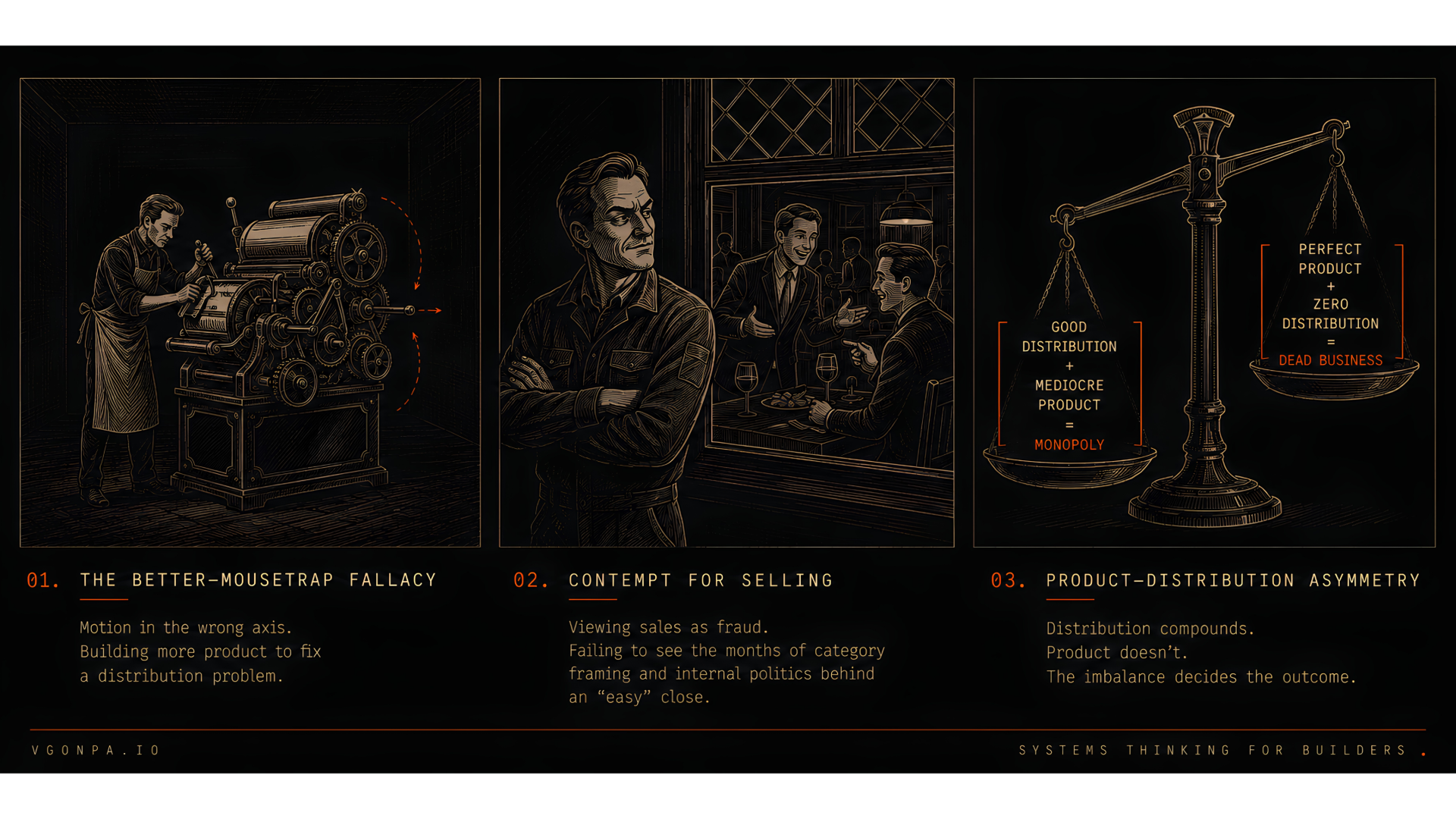
The first is the better-mousetrap fallacy itself: if we build it, they will come. It is seductive because it lets you stay where you are good. You stay in your comfort zone. The work is in the product, the satisfaction is in the product, so the explanation for why nobody showed up must also be in the product. You build more product. It feels like progress, and it is motion in the wrong axis.
The second is contempt for selling as low-status work. Good selling looks effortless. A two-hour lunch, one phone call, “it basically closed itself.” That effortlessness reads as proof there was no real work in it, the way a well-built distributed system looks simple right up until you try to build one. The engineer who sees the easy signature does not see the months of category framing, internal politics, champion building, and budget timing that made it possible. Thiel is blunt about both halves: “it takes hard work to make sales look easy,” and Silicon Valley engineers “think of sales and marketing as a sort of fraud.” Not seeing the effort is not evidence the effort was absent. It is evidence it was done well.
The third is the asymmetry between product and distribution. The two are not symmetric. Thiel again: “Superior sales and distribution by itself can create a monopoly, even with no product differentiation.” Run it the other way and the asymmetry is brutal: “If you’ve invented something new but you haven’t invented an effective way to sell it, you have a bad business, no matter how good the product.” Good distribution with a mediocre product can win. An excellent product with no distribution is not a smaller business. It is a bad one.
Distribution is the ticket to get you into the party. Without it you are not playing a worse hand: you are not even in the room, you do not even compete. You lost before you started, no matter how good your product would have been.
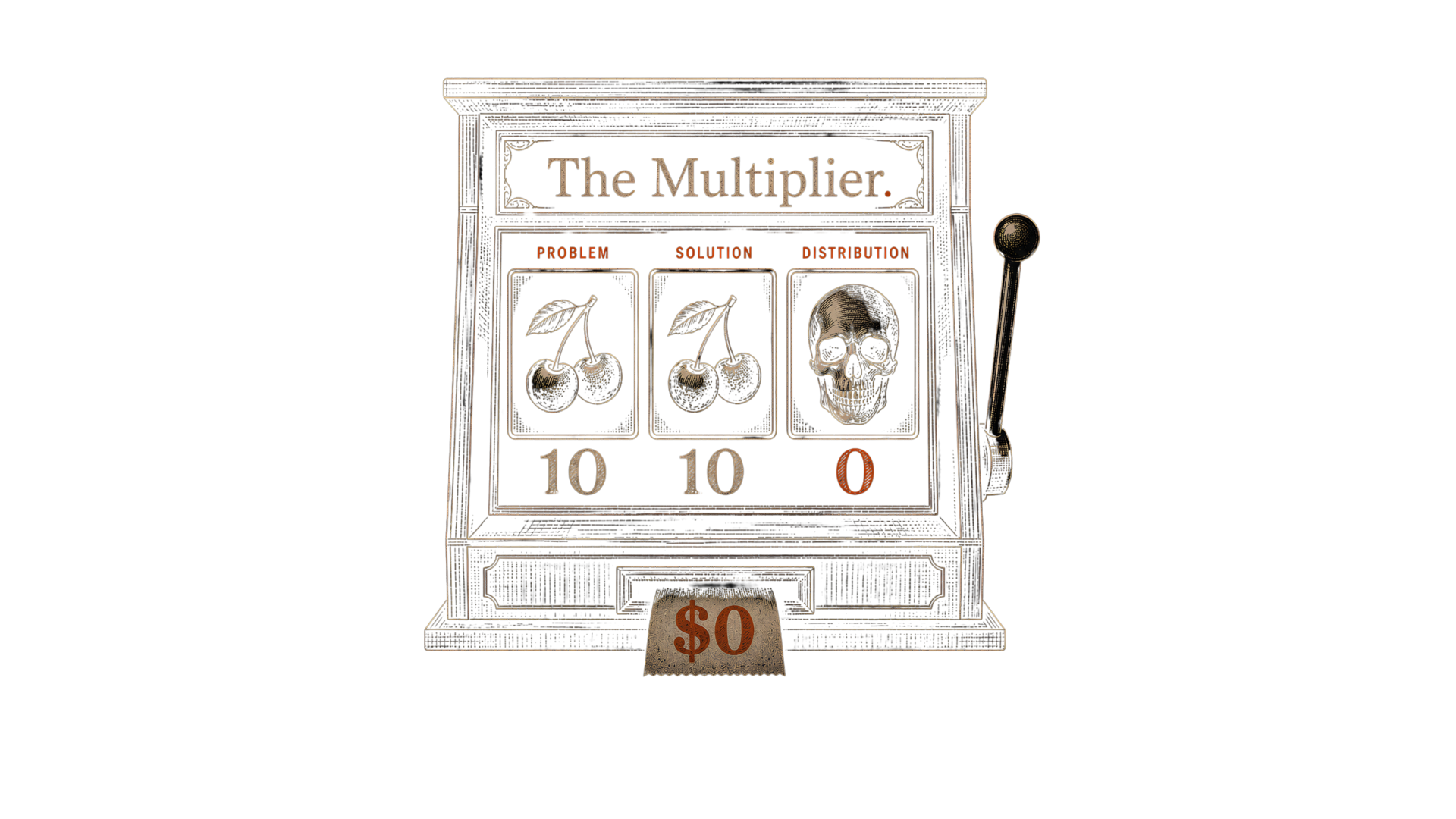
I am going to write this as an equation, because that is how we engineers understand it best. You usually see it with two terms, Product times Distribution. That is the right shape, a multiplication where a zero anywhere zeroes the whole thing, but it is incomplete. That single word “Product” is hiding two different things the Canvas keeps apart: the problem and the solution. Open it into those two, and the equation reads with three terms:
Business = Problem × Solution × Distribution
It is a multiplication, so any one of the three at zero takes the whole business to zero. A problem that genuinely hurts, with no solution, is not a business. A brilliant solution to a problem nobody cares about is not a business either. And the best solution to the best problem, if it reaches no one, is worth exactly zero. Ten times zero times anything is still zero.
And winning your product war guarantees nothing, because the axis you optimized may not be the axis that decides. Blu-ray won every fight it picked and lost the war anyway, because the war moved to a channel it was not even fighting on. The ticket gets you into the party. It does not guarantee you are dancing to the right song.
Marc Andreessen put the same warning from the market side: the only thing that matters is reaching the point where a real market clearly wants what you have built, and a market is not a group of people who would like your idea if they understood it. A market is a structure of demand, budget, urgency, channels and alternatives. A product that cannot reach that structure has not met the market. It has only imagined it.
So the engineer’s blind spot is not that distribution is the only thing that decides. It is that distribution is the piece he ignores, while he pours everything into the one piece where “better” is a fact, the solution. The equation and the Business Model Canvas are one model spoken in two idioms, the equation for the engineer and the canvas for the business, and both say the same thing: there is more than one piece, and you are skipping one. Justin Kan caught the founder version of the bias: “First time founders are obsessed with product. Second time founders are obsessed with distribution.” He added later that the line did not age super well, but the bias it names is real. The point is not that product is irrelevant. The point is which obsession you reach for first, and how many pieces you forget exist.
My own case
We built this twice, and both times we lost it. Before I go on, let me tell you who we are and what FITIZENS is, because you may not know either. FITIZENS was the company Dani and I ran for about four years. We built an AI coach: the idea was to analyze how you move when you train, a squat, a deadlift, a pull-up, and hand you back a score for the quality of your technique along with advice to improve it. We tried it twice, with two different products, and both times we went deeper than the competitor products we tested in the part that is genuinely hard, the movement-quality detection, with cleaner detection and a tidier interface than the ones we held in our hands. Two better mousetraps, and both of them ended in a closed file cabinet. We made that mistake knowing by heart the history I just told you, which is the part I keep coming back to.
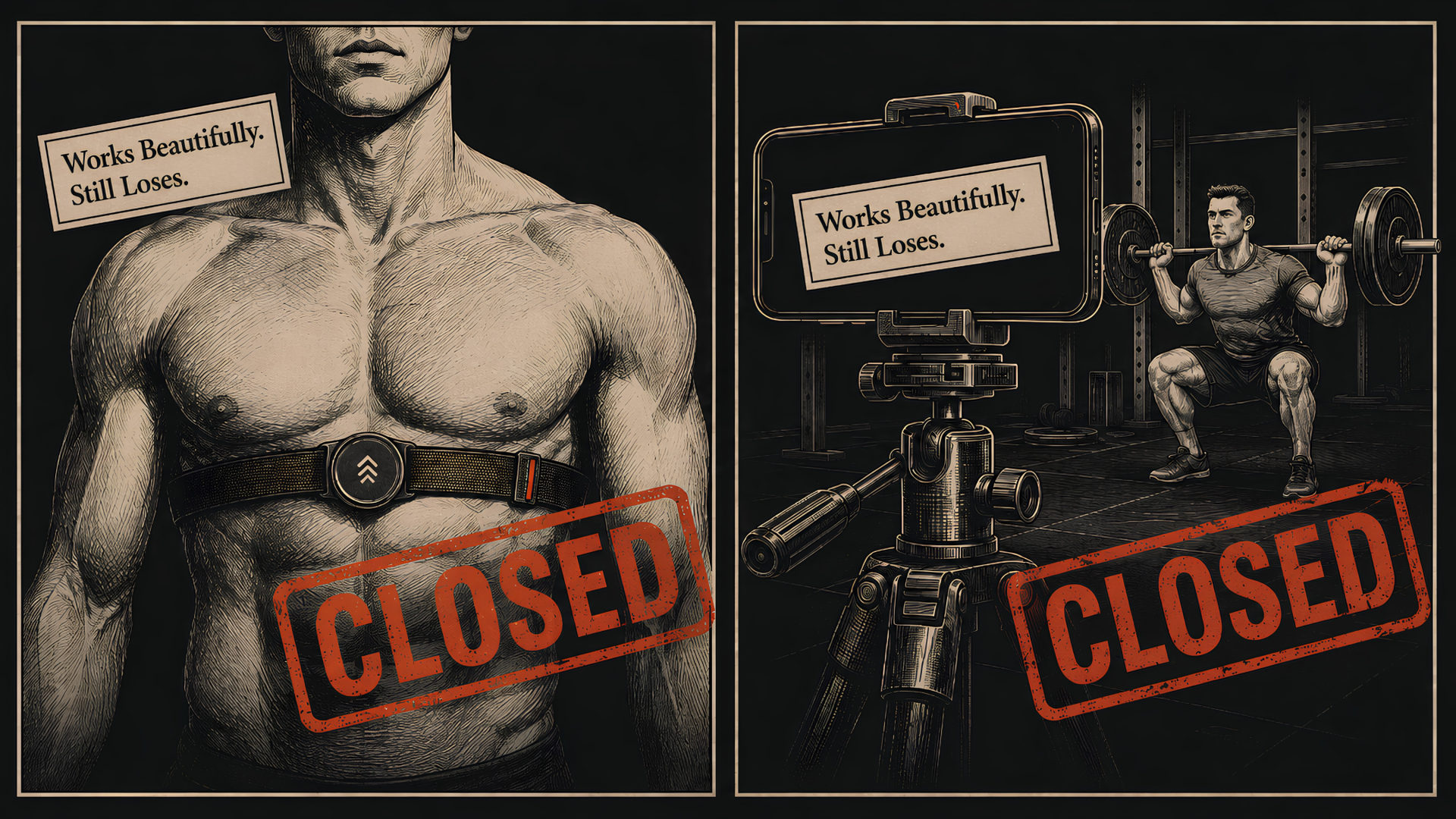
The first version was a sensor. You wore the sensor on your body, and from your movement it computed the quality of your technique and your performance metrics while you trained. It worked, and it tracked movement more cleanly and showed a tidier interface than the products we actually held in our hands. I mean the ones we touched for real. We had the first two pieces of the business. We understood the problem: athletes want to know whether they are doing it right. And we had the solution: we knew how to measure that quality. What killed us was the third piece, the distribution. What we were selling was hardware, and hardware is the most expensive thing in the world to put in people’s hands: money up front, inventory risk, a long road from a unit that works to a unit you can sell at scale. To cross that gap we needed venture capital, and we did not raise it. We chose to do it with our own money, and that decision ran us dry before we understood what it had cost us. The product was better than what we tested and we still could not move it. The solution sat near ten and the distribution sat at zero, so the business sat at zero.
So we pivoted to a video coach. This time we solved distribution by design. This round there was no hardware: you pointed a phone camera to you while executing an exercise and the app scored it and produced feedback so you could improve your form. As every other digital product it circulates for almost nothing, no inventory, no shipping, no working capital tied up in boxes, so the cost to reach users came down to a marketing budget. We got ahead of the field again, and this time the field was working from video too. We did the same job the video products we tested did, with simpler technology and more depth in the part that is hard, assessing consistently the user movements. Now we had the solution and we had the distribution too. What we did not have, this time, was the first piece, the problem. We had built a vitamin instead of a painkiller. We went after a niche with no real pain, helping people improve their technique, and improving your technique is something people don’t want more than something they hurt for. The product was excellent, it worked, people liked it, and they rated it highly when we asked. But it was not sticky. Usage fell off around the fourth week in our trials, because we were not solving anything that hurt. The problem sat at zero, so the business sat at zero again, now from the other side.
Somewhere in there the self-funding ran out, and so did the time, and so did the energy.
The lesson is not the cliché where the founder hides in the building and refuses to sell. The misses were structural. With the sensor, the channel was hardware and we did not raise the capital that channel needs. With the video coach, the channel worked but the problem underneath it did not hurt enough, and we ran out of road to pivot from a vitamin to a painkiller. The hole was never in the product, and it was never a refusal to leave the office. It was a different piece each time.
The market keeps the problem and the solution apart, and the equation should too. That is why I write it with three terms and not two. With the sensor we had Problem and Solution and missed Distribution. With the video coach we had Solution and Distribution and missed Problem. Both times one term sat at zero, and one term at zero is the whole business at zero.
That is the structure I would change now, not the ambition.
Distribution is a system, which means you already know how to build it
The fairy-tale framing hides the piece that gives the agency back. The three pieces are not three dark arts practiced by people unlike you. The one engineers fear most, distribution, is a system with inputs, outputs, bottlenecks, conversion rates, and feedback loops. That is exactly what an engineer is trained to model.
Treat the funnel as an architecture. Discovery, activation, retention, referral are stages, and each layer has a contract with the next one. A user who hears about the product but does not understand why it matters is a failed handoff. A user who understands the value but cannot buy easily is a failed handoff. A user who buys but never reaches the first valuable moment is a failed handoff. Instrument every step the way you would instrument a request path. Find where the volume collapses, the worst conversion in the chain, and treat that step as a priority bug, not a marketing vibe. Fix it, measure again, move to the next bottleneck. This is iteration with data, which is the thing you already do for a living.
Thiel sets the bar lower than founders assume. Most businesses never get a single distribution channel to work. You do not need many. You need one that works end to end: people discover your product, understand it, can buy it without effort, and come back. As Thiel puts it, “if you can get just one distribution channel to work, you have a great business.” The word one matters, because each channel asks for a different way of selling. Selling a ten-euro app is not the same as selling a hundred-thousand-euro enterprise contract. The ten-euro app cannot afford a sales team calling customers one by one: the math does not work. The hundred-thousand-euro contract justifies that motion, and in fact it needs it. So the goal is not to stay busy doing marketing everywhere. The goal is to find the channel that fits your product and master it. That is an engineering goal, the kind you attack step by step. And it is exactly what we did not do on the first round with the sensor: we never found that single channel that carried the product all the way to the customer.
What I would change
If you take one thing from these four years, take this: when products are already good enough, technical quality stops being the thing that decides, and the work that does decide is the work engineers are trained to look down on.
You can hold the whole essay in a single line. A business is Problem times Solution times Distribution, and it is a multiplication, so any one of the three at zero takes the whole thing to zero. Find a problem that actually hurts. Know how to solve it. Get the solution to the people who have the problem. Miss any one and a brilliant score on the other two buys you nothing. We had Problem and Solution and missed Distribution with the sensor. We had Solution and Distribution and missed Problem with the video coach. Both times one piece sat at zero, and one piece at zero was the whole company at zero.
The trap is that the piece you can measure is the one you keep pouring into. “Better” is a fact in the product, a number you can read off a benchmark, so that is where the work feels real and where the comfort lives. Distribution offers no such certainty, so the instinct is to avoid it and build more product, and building more product feels like progress while you drift further from the thing that would have saved you. That instinct cost us a company.
And the part I wish I had believed four years earlier is that distribution is not a dark art practiced by people unlike you. It is a system with inputs, outputs, bottlenecks and feedback loops, the exact kind of thing you already model for a living. Treat the funnel like an architecture, instrument every step, find where the volume collapses, fix that step like a priority bug, measure again. You do not need ten channels. You need one that works end to end. That is a tractable engineering goal, and it sits right next to the one you already love.
What broke FITIZENS was never an unwillingness to build. We built relentlessly, for four years, while paying for it ourselves. The ambition was right. The structure around it was not. If I start again, that is what I change.
Sources
- Peter Thiel, Zero to One (2014), ch. 11 “If You Build It, Will They Come?”: https://fourweekmba.com/sales-distribution-peter-thiel/
- Marc Andreessen, “The Pmarca Guide to Startups, part 4: The only thing that matters” (2007): https://pmarchive.com/guide_to_startups_part4.html
- Justin Kan, X, 7 Nov 2018: https://x.com/justinkan/status/1059989657218248704
- “Build a better mousetrap” (apocryphal, not Emerson’s literal line): https://quoteinvestigator.com/2015/03/24/mousetrap/
- Videotape format war (Betamax vs VHS): https://en.wikipedia.org/wiki/Videotape_format_war
- High-definition optical disc format war (HD-DVD vs Blu-ray): https://en.wikipedia.org/wiki/High-definition_optical_disc_format_war
- DVD/Blu-ray US sales down ~93% since 2005 (DEG): https://cordcuttersnews.com/dvd-blu-ray-sales-plummet-over-93-since-2005-peak-dipping-below-1-billion-in-2024/
- Streaming convenience beat free piracy (Spotify/Netflix; Sweden music piracy fell after Spotify): https://www.digitaltrends.com/music/spotify-music-piracy-decline-study/
- Xerox Star: https://en.wikipedia.org/wiki/Xerox_Star